

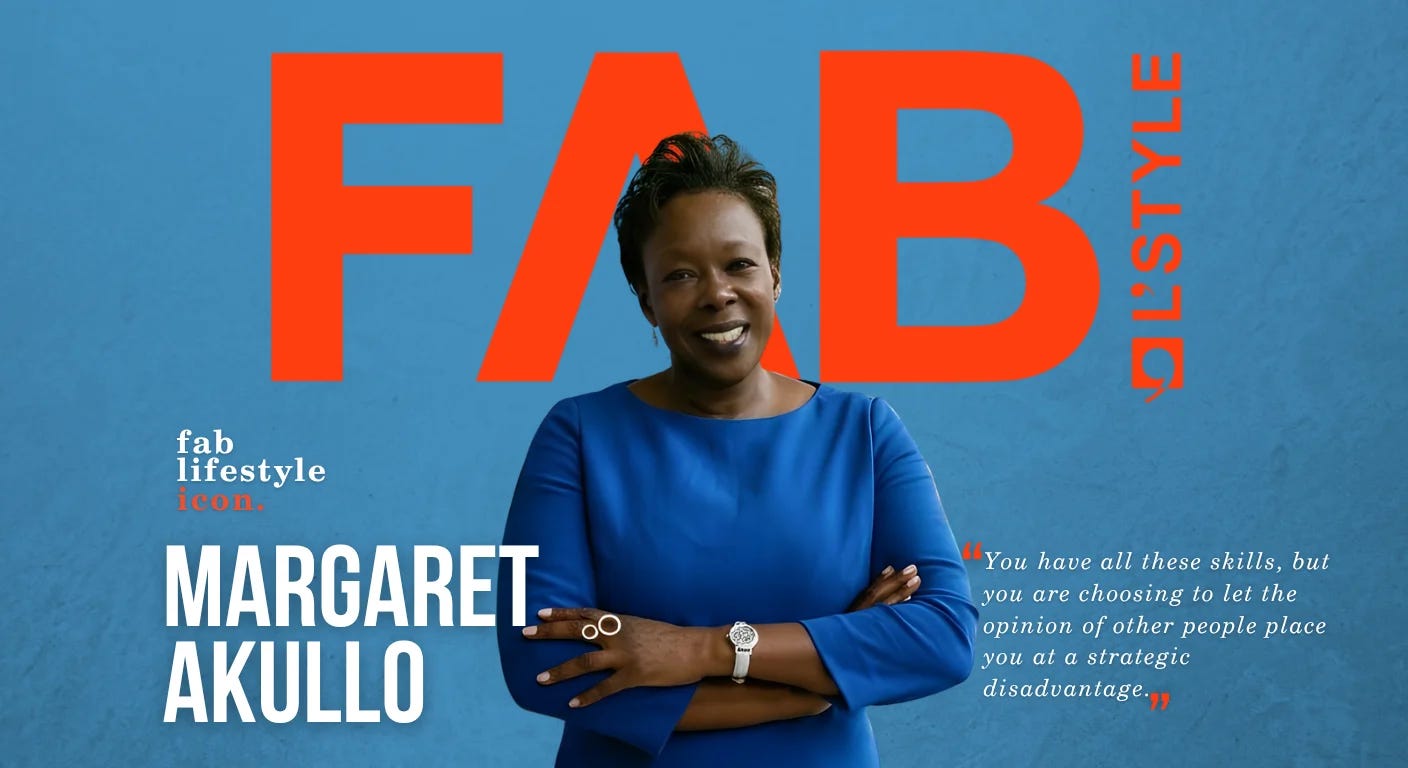
For Margaret Akullo, those questions have followed her across four continents, from childhood in Uganda (East Africa) and Ghana (West Africa) to leadership roles in international criminal justice, and now into a new chapter centred on mentoring the next generation.
Readers familiar with her writing or public talks will recognise some of the stories. The little girl waving an OAU flag with pride. The African in the diaspora repeatedly asked whether she was “really” Ugandan because she did not fit people’s expectations. The African who boldly retired early from the UN. These stories have become part of her public narrative because they illustrate ideas that continue to shape her work: identity, belonging and the confidence to recognise one’s own value.
Yet the FAB L’Style magazine interview reveals something deeper than the familiar anecdotes.
Behind the polished public profile is a life marked by experiences that could not have been planned into a leadership story. As a child growing up during periods of political instability in Uganda, she remembers soldiers, fear and uncertainty. She recalls having a gun pointed at her as a young girl and taking cover in a car as armed soldiers walked nearby. These are not motivational moments. They are memories that explain why justice, safety and human dignity became lifelong commitments rather than professional interests.
Those commitments eventually led to more than three decades working across policing, criminal justice reform and international development, including twelve years with the United Nations. Her work addressed some of the world’s most difficult challenges, from human trafficking and organised crime to child protection and criminal justice reform.
But experience also brought uncomfortable questions.
The interview reflects candidly on her growing sense that large institutions often struggle to deliver the inclusive, locally driven change they aspire to create. She speaks carefully rather than critically, acknowledging the realities of donor priorities, bureaucracy and the complexity of international systems without reducing them to simple villains. It is less an attack on institutions than an explanation of why she eventually chose a different path.
Aged 55, leaving the United Nations in 2022 was not a retirement from purpose. It was a decision to work differently.
Today, through her Impact Leaders Initiative, Margaret Akullo mentors small cohorts of emerging professionals, helping them move from uncertainty to action. While she uses established leadership frameworks such as Ikigai and her own Mindset to Output approach, the real value of her work lies elsewhere. It comes from lived experience across countries and cultures, decades of leadership roles and an understanding that professional success begins with clarity about identity, hence her ethos ‘shaping leadership from the inside out’.
The interview makes one thing clear. Margaret Akullo’s greatest asset is not a framework or a methodology. It is perspective earned through years of difficult decisions, cross-cultural leadership and service in places where the stakes were often measured in people’s lives rather than organisational performance.
That perspective now shapes a quieter form of leadership. Instead of managing large international programmes, she invests deeply in a handful of people at a time. Instead of measuring impact through budgets or projects, she measures it through confidence rebuilt, careers redirected and leaders who learn to recognise the value they already possess.
It is a different definition of influence, but perhaps a more enduring one - her quiet yet impactful portfolio of influence.
To discover the full conversation, including her reflections on identity, leadership, international development and life after the United Nations, read the complete magazine interview at https://fablstyle.com/margaret-akullo-africa-future-leadership/