

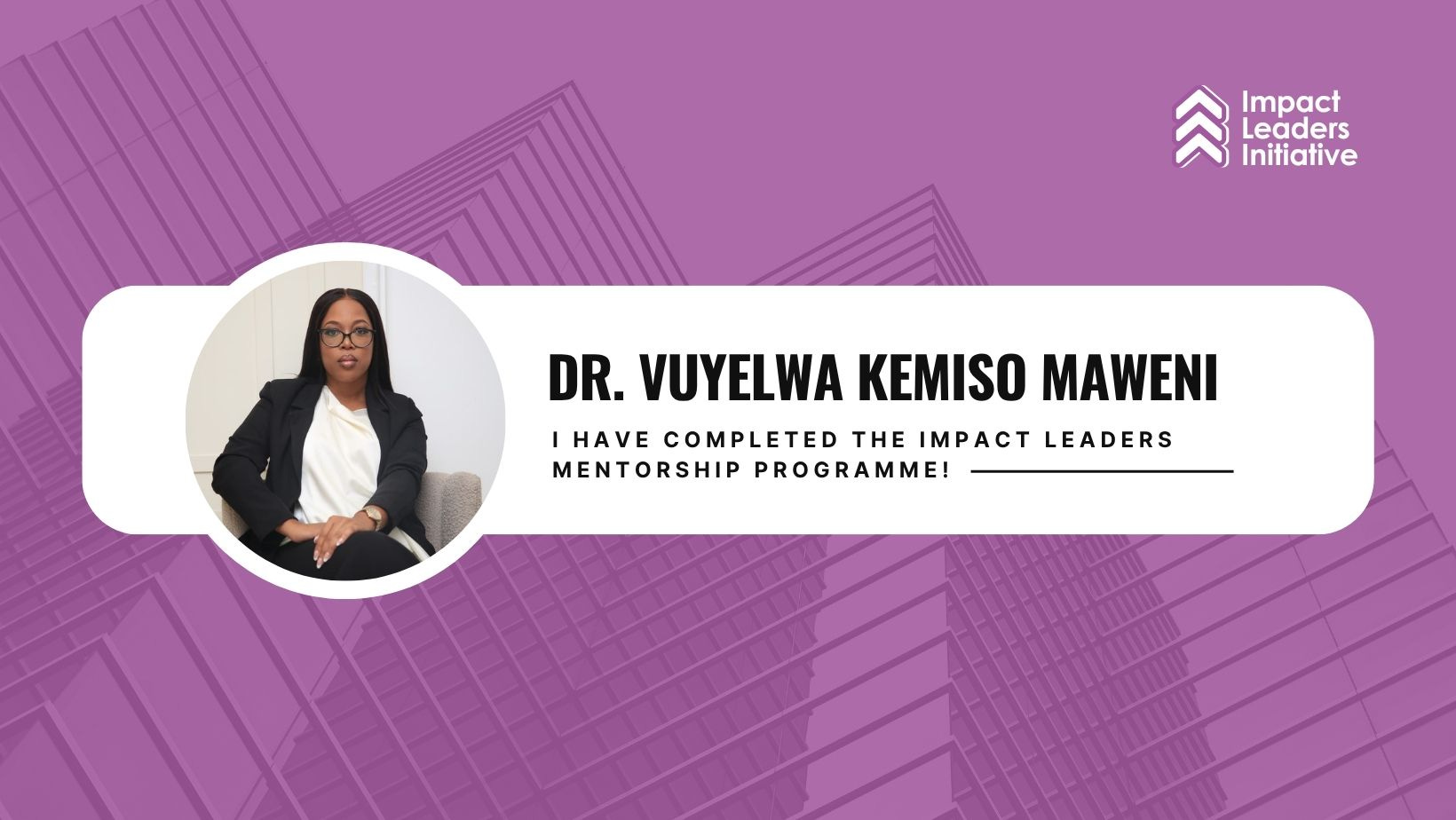
For years, I carried a label that felt both accurate and limiting. Emerging scholar. It implied potential, yes, but it also implied incompleteness, as though the work I had already done, the students I had taught, the research I had published, the leadership roles I had taken on, including community engagement, were all prologue to something that had not yet arrived.
I am a criminologist, researcher, and lecturer at the University of KwaZulu-Natal, South Africa. My work sits at the intersection of police culture, offender rehabilitation, victimology, criminal justice reform, and broader questions of crime and justice in the African context. On paper, I had accumulated a credible body of work and yet in practice, I was still waiting for permission to fully claim it.

That is what brought me to the Impact Leaders Mentorship Programme. I joined for six one-to-one sessions with the programme’s director, Ms. Margaret Akullo. I came in with two concrete goals: submit an abstract to the European Society of Criminology (Eurocrim 2026) conference and complete a professional positioning statement. Both were achieved. The Eurocrim abstract was accepted and the positioning statement, which I submitted as a rough draft, was refined through Ms. Margaret’s feedback into something that honestly reflects my current role and aspirations. By any measure, those were the outputs.
But the outputs were not the point.
The moment that changed something was a conversation about the Eurocrim 2026 conference. My initial assumption, stated plainly and without much reflection, was that if my abstract were accepted I would present my academic paper virtually. Online felt obvious, manageable and safe. Ms. Margaret challenged that directly and pointed out that presenting in person would do something a video call never could: it would put my African criminology research in a European room for my first time, in person, outside Africa. I sat with that observation for a long time after the session ended and eventually decided to attend the conference in person.
What I came to understand through the mentorship programme was that my professional self-perception had not kept pace with my professional reality. The Ikigai exercise that Ms. Margaret used early in our sessions made this visible in a way that was uncomfortable and necessary. It revealed that I had not fully claimed my professional identity, not because the identity was not there, but because I had not stopped long enough to acknowledge it.
The programme also revealed something I had underestimated: visibility - the deliberate, honest documentation of one’s work and presence in their field. LinkedIn came up repeatedly in our discussions, and I understood the argument intellectually.
Professionals who are active, who share their thinking and engage with others, create opportunities that people who work quietly and wait to be found do not. My plan is to fully act on this.
Beyond the sessions themselves, Ms. Margaret consistently sent information about international calls for papers, scholarships, and grants relevant to my work. That kind of active, ongoing investment in someone else’s growth is not a given, and I did not take it for granted.
There are things I want to do differently in the coming months - more visible engagement with the wider scholarly community; a deliberate pursuit of opportunities outside my immediate comfort zone; and a rebalancing of how I distribute my professional attention, by moving towards a fuller engagement with research, writing, and the broader criminology field.
But the shift that mattered most was quieter than any of those actions. I stopped thinking of myself as someone who was emerging as a criminologist. I started thinking of myself as one. The work was always there. What changed was my willingness to stand behind it. Sometimes growth is not about becoming someone new. Sometimes it is about finally recognising the professional you have already become.
About the Author
Dr. Vuyelwa Kemiso Maweni is a criminologist, researcher, and lecturer in Criminology and Forensic Studies at the University of KwaZulu-Natal, South Africa. Her research focuses on police culture, human trafficking, corrections, and gender-based violence in the African context. She has supervised Honours and Master’s students to completion, co-published with several of them, and serves as Newsletter Editor for the Criminological Society of Africa. She is currently preparing to present her research at the 26th Annual Conference of the European Society of Criminology taking place in Warsaw, Poland, in September 2026.