

They come from Ghana, Nigeria, Japan-Britain, Uganda-Britain, and South Africa. Five women and two men. A criminologist. communications intern. A business operations manager. A bank clerk. A program manager. A risk management and data analytics professional. A university student of politics and international relations building her voice.
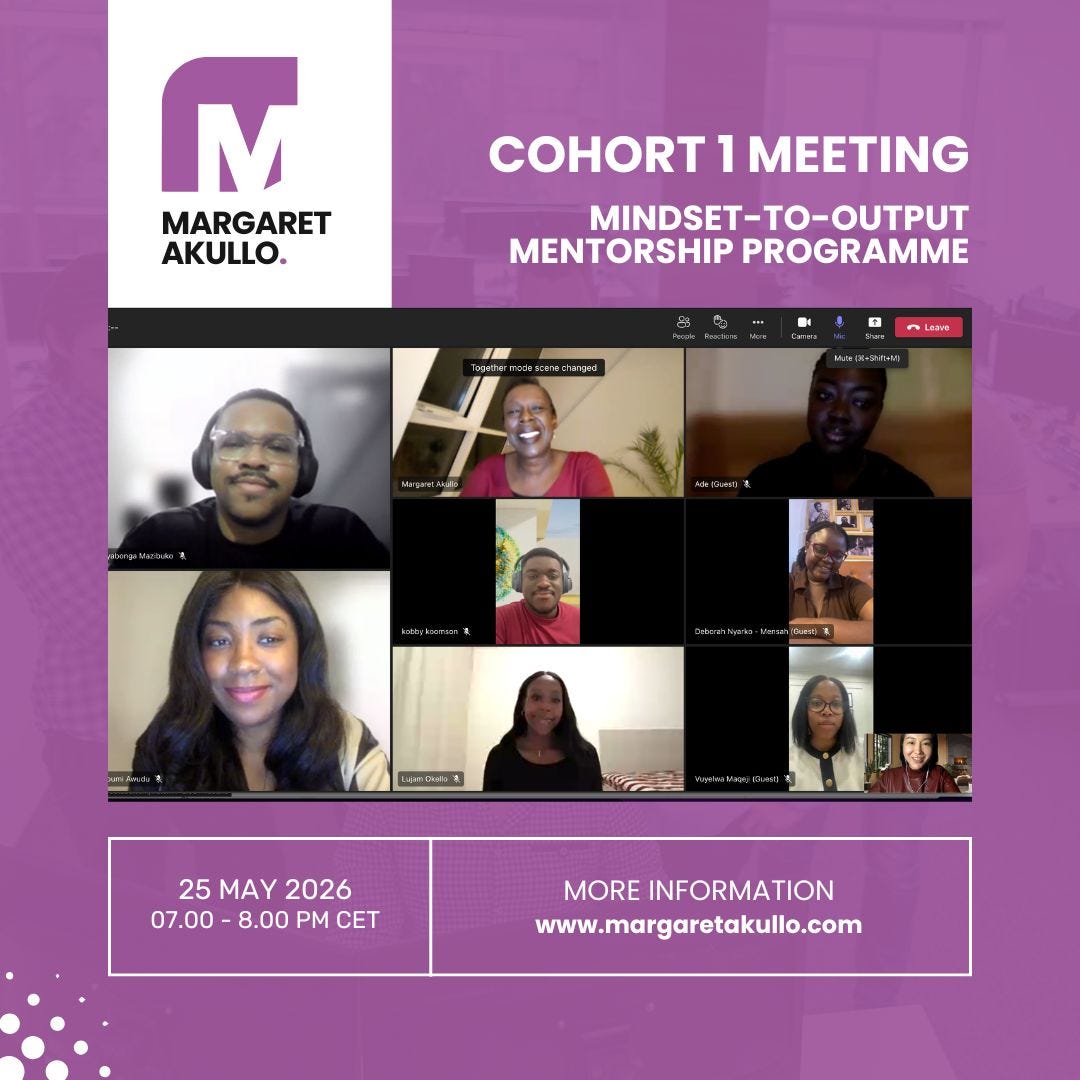
At the start of our first cohort meeting, I asked them a simple question: in one to three words, where are you right now in your career or life? Their answers were immediate and honest.
Early stage. Season of planting. Building. Positioning. Pivoting. Developing.
In those few words, an entire room told the truth about where they were — not where they hoped to be, not where they felt they should be, but where they actually were. That honesty told me everything I needed to know about who I was working with. When I read their applications for mentorship and met each of them in our first conversations, I found the same thread running through every single one. They were all more capable than they believed themselves to be.
Across every application and every answer to the question of what they are good at and what they can offer the world, I saw people who had the evidence of their own capability but had not yet fully claimed it. I recognise this pattern because it is not unique to this cohort. It is one of the most consistent things I encounter in emerging leaders, particularly those navigating career transitions, and those who are, for the first time, trying to make themselves recognised in a world that has not always valued what they bring.
The Mindset-to-Output Mentorship Programme is not a coaching series or a personal development course. It is a structured, deliverable-focused engagement that begins with a goal and ends with something finished — a portfolio, a presentation, a proposal, a personal statement, a strategy document, a research abstract, a professional identity that is ready for the world. The internal work — the mindset, the clarity, the confidence — happens through the act of producing something real. Not through talking about it but through doing it.
What moves me most about this particular cohort is the diversity of thought and purpose they carry. One is building a research voice that advocates for victims within criminal justice systems. Another is translating a decade of humanitarian data work into a portfolio that speaks to a new market. One is committed to creating platforms and visibility for African creatives who have been systematically overlooked. There is a creative communications professional who turns complex ideas into stories that resonate and is now seeking to build a platform that reflects her talent. Another is a bank clerk with ambitions to move into international relations and human rights. One is learning how to find their footing within corporate environments while building the strategic confidence to navigate them on their own terms. And there is an undergraduate student of politics and international relations who delivered a speech on climate change at sixteen and is only now beginning to appreciate the reach of her voice.
Some are meeting for the first time but they share something that matters more than geography or field of work or career stage. They share the willingness to show up, do the work, and be intellectually honest about where they are. In my experience, that combination — willingness, work ethic, and honesty — is more valuable than almost any technical skill.
The first cohort of the Mindset-to-Output Mentorship Programme has begun. Seven people. Five countries. One thread. By the end of their mentorship, each of them will have something finished in their hands - the output. Something they built. Something that proves the gap between intention and output is not as wide as it once felt. Whether you are in an early stage, a season of planting, building, positioning, pivoting or developing — the work begins where you are, and for this cohort, it has already begun.
As the youngest in the cohort and the Uganda-British voice, this programme is pushing me to not just recognise my potential, but actually produce something that proves it. I am grateful to be part of a space that turns quiet ambition into real output.